Review: The Time Traveler’s Wife, by Audrey Niffenegger

I confess, I had absolutely no idea what I was about to read when I was given a copy of The Time Traveler’s Wife. I had heard the title, of course, as it was a popular book club book for a while there, and I think Oprah may have endorsed it at some point. But as I am not a member of a book club and never watched Oprah (except when she gave stuff away, because I like to live vicariously), I didn’t know anything about it.

I was kind of expecting the title to be a metaphor for something. I wasn’t exactly sure what.

But no. This book is about a time-traveler. And his wife.

The book opens on the day when Henry DeTamble, a 28-year-old ponytailed librarian, first meets Clare Abshire, a bubbly and beautiful girl of 20. Let me be clear: it’s the day Henry first meets Clare. It’s not the first day Clare meets Henry, because Clare has known Henry since she was 6.

Confused yet?

Henry DeTamble, through no fault or effort of his own, is a time traveler. Sometimes when he is under stress, or looks at a blinking light, or is excited, or for no reason whatsoever, he finds himself involuntarily traveling through time. He arrives at an unknown time and place, stark naked, not knowing how long he will be there or any way to get back.

Henry knows all of this, since he has been time traveling since he was 5 years old. What is news to him is that an older version of himself will travel back in time, many times, to visit Clare as a child and teenager. Clare has grown up with Henry as her best friend, her confidante, her protector, knowing that she will someday marry him.

Now, before you start thinking “Ew, so this middle-aged guy travels back in time to a little kid and falls in love with her? Gross,” let me assure you that’s not how it happens. (No Twilight comparisons here). For Henry, he meets Clare as an adult, falls in love with her, marries her, and then finds himself constantly pulled unwittingly to her childhood, where he puts forth every effort to be entirely proper and appropriate with her younger self.

The only reason that Clare knows they will get married is because she’s a really wily and persistent teenager, and eventually manages to weasel the information out of him.

The book mostly follows Henry linearly through his nonlinear life. It details his courtship and marriage to Clare, and the trials and joys they face in their relationship. The only catch is that throughout the course of their relationship, we also accompany Henry as he visits the past and future, crossing paths with younger and older versions of himself, Clare, and their family and friends. It also, as the title suggests, shows us Clare’s struggle as she tries to have a normal life with a decidedly abnormal man.

As with most stories involving time travel, this one operates according to its own set of rules. My only rule when dealing with time travel stories is that I need the rules of the story to make sense and be consistent. Ms. Niffenegger (side note: I love the author’s name) does an excellent job making sure her characters and narrative adhere to the rules of their world.

The first-person narrative alternates between Henry and Clare’s voices. It is very easy to follow, since each time the narrator changes, the paragraph is headed with the character’s name, age, and the date.

I really enjoyed this story. When you boil it down to its bones, it’s simply a story of two people trying to make their relationship work, in spite of the world not always working in their favor. I would probably like it if that was all there was to it; however, the fact that the main thing working against them is the sci-fi element of involuntary time travel adds a freshness and uniqueness to the story that I loved.

I loved the characters of Henry and Clare. They both have their strengths and flaws. Ms. Niffenegger gives them each a distinct voice and personality, so I felt like I really knew them. I could understand how they fell in love, how they complemented each other, how they frustrated each other. Their relationship seemed real and substantive to me, and I found myself fully invested in these characters.

Also, while it’s easy to assume a book about time travel would fall solidly into the genre of science fiction, it’s not that simple. Henry’s time traveling (which is explained in the book as a genetic anomaly) is the only fantastical element of the story. It takes place over the last few decades. There have been no great leaps in science, evolution, medicine, space travel — basically, this is the world we are all familiar with. So although I love a good sci-fi story and therefore may not be the best person to judge this, I think this book would appeal even to those who have never read or enjoyed a sci-fi book in their lives.

The Time-Traveler’s Wife is in turns sweet, melancholy, exciting, and heartbreaking. It is a lovely story about normal people in both ordinary and extraordinary circumstances. I loved journeying through the struggles and triumphs of Clare and Henry, and I missed them when the story was over.

Content guide: Contains sex, profanity, occasional drug use and violence.

Review: Ender’s Game by Orson Scott Card (@orsonscottcard)

I’ve decided that if I’m going to have a blog where I review books, I need to review my favorites, even if they’ve been out for years and years. I owe it to the world (well, or at least whatever small percentage of the world reads my blog) to let them know why these books are amazing. And I couldn’t think of a better one to start with than Ender’s Game.

Image

Plot:

It is the future. Earth has survived an attack from an insectile alien race – barely. Population control laws are in effect. Families are limited to 2 children. Young children are monitored to see if they have military potential, and those that show promise at an early age are whisked away to train in the military’s Battle School, in the hopes that by the time they reach adulthood, they will possess the necessary skills to defend the Earth, if the aliens – “buggers” – ever return.

Andrew “Ender” Wiggin is a rare third child in his family. His older brother and sister showed intellectual promise, but his brother was too ruthless and his sister too compassionate to qualify for Battle School. So the Wiggin parents were permitted a third chance to produce a military prodigy. And they succeeded.

Ender is whisked away to Battle School at the ripe old age of 6. The School, located on a space station orbiting the Earth, is populated by military officers and child prodigies. Ender is one of the youngest.

And these are not your average children.

They train daily in space military tactics, weaponry, and combat. Although they are all at an age that we associate with Dora, Spongebob, and Hannah Montana, these kids are nothing like the children currently roaming your local elementary school hallway. They are calculating, intuitive, sometimes ruthless, always dangerous.

One of the main focuses of the School is the battleroom, where the children are equipped with special suits and laser guns that allow them to fight each other in zero-gravity. On Ender’s first trip to the battleroom, it becomes quickly apparent that he is a cut above the other students. Some of his peers respect this. Some are threatened by it.

And as Ender works his way up through the ranks of Battle School, his teachers take notice, and wonder if perhaps Ender is the child they’ve been waiting for. The child who can change everything. The child who can save Earth.

Why I Love It:

Don’t let the summary throw you off. Ender’s Game may be a book about children, but it is by no means a book for children. The children in this book are nothing like how we picture children (as the mother of an almost-6-year-old, I can say this pretty definitively). Everything about this book is aimed at an adult audience.

Ender’s Game is not a thriller or adventure story, although some of the battleroom scenes are exciting. More than anything, it’s an examination of the mind of Ender Wiggin, the culture he lives in, and a world under military rule. And it’s all fascinating.

Mr. Card writes Ender in a way that while you understand he is just a child, you can still be awed, chilled, and amazed at his thoughts and actions. As a matter of fact, all of the characters are interesting and intriguing, from his friends at the Battle School, to his sociopath brother Peter, to the Commander of the Battle School, Colonel Graff.

There is a twist at the end of Ender’s Game. You may see it coming; you may not. I did, but it didn’t lessen my enjoyment of the book one bit. The fact that I have read this book over and over again, in spite of knowing the twist ending, speaks to the strong writing of the rest of the book. The book doesn’t exist just to throw you off at the end. The book exists to make you think, to draw you completely into the character of Ender, and to absorb you in the science-fiction world he lives in.

When one book just isn’t enough:

There are 4 sequels to Ender’s Game. They follow him into adulthood, far past the end of Ender’s Game. I love the sequels, but they’re very different in tone and scope from Ender’s Game; however, I did find that they resembled each other. So my suggestion is that if you enjoyed Ender’s Game (and I really, really hope you do), check out Speaker for the Dead from your local library, read the whole thing, and then decide if you want to keep going.

The sequels are:
Speaker for the Dead

Xenocide

Children of the Mind

Ender in Exile 

There is also a companion series to the Ender’s Game series, paralleling Ender’s story from the point-of-view of one of the secondary characters. It sounds weird – why would you want to read the same story all over again, knowing how it ends? But the Ender’s Shadow series is wonderful (only the first book parallels Ender’s Game. After that, its sequels detail events barely alluded to in the Ender’s Game sequels).

Content guide: Contains some disturbing scenes of violence towards and committed by children.

Review: Pandemonium, by Lauren Oliver (@oliverbooks @harperteen)

WARNING: Spoilers for Delirium ahead.

Pandemonium is the second book in Lauren Oliver’s Delirium Trilogy. In the first book, Delirium, Lena lives in a future dystopian United States, where love has been designated a disease, and everyone is cured on their 18th birthday. Lena was eagerly anticipating her “cure” and her orderly, predictable life to follow, free from the “Deliria” that leads to mood swings, irrational behavior, violence, and death. That is, until she meets Alex, an “Invalid” from The Wilds – a boy who has never been cured and doesn’t believe that love is something that needs a cure. Alex teaches Lena about love, and they plan to escape Portland to live in The Wilds together. But in the end, Alex sacrifices himself to allow Lena to escape.

Pandemonium’s narrative alternates between two separate time lines. The first picks up right where Delirium ends. It follows Lena in the days, weeks, and months after she has escaped Portland, losing Alex in the process. Predictably, she meets up with other Invalids living in The Wilds, and slowly assimilates to life with them. Away from the familiar comforts of the city. Away from fear of the Deliria. Away from Alex.

The second takes place several months later. Lena is now an active part of the resistance, and is living undercover in New York City. Her cover is that she is part of a new political movement – the DFA or “Deliria-Free America.” The movement’s mission is for the cure to be administered to everyone in America before their 18th birthday. Lena’s mission is to keep an eye on the DFA, especially its leaders: Thomas Fineman and his son, Julian.

[Spoilers Ahead]

But everything turns to chaos when Scavengers – a violent extremist group of uncureds – attack a DFA rally, and Lena and Julian are kidnapped and held hostage together. Their captivity forces them to question their preconceived notions about each other and about who their enemies really are.

Pandemonium was an enjoyable, exciting, fast-paced book. I did find it a bit predictable – I wasn’t nearly as surprised as Lena at the twists and turns of the plot – but that didn’t lessen my enjoyment of it at all. And as much as I loved Alex in Delirium and I wasn’t sure initially if I would be able to accept if Lena moved on, I found that I loved Julian just as much as Alex. I appreciated how the evolution of Lena and Julian’s relationship mirrored that of Lena and Alex – but with Lena’s role reversed.

Ultimately, I thought Pandemonium was a great set-up for the third book in the trilogy. I anticipate the conclusion to the Delirium Trilogy will contain lots of action, a likely love triangle (which is overdone in YA books, but in a world where the entire plot focuses around the benefits and drawbacks of falling in love, it probably can’t be avoided), and Lena’s deeper involvement with the resistance. It answered some questions set up in Delirium while asking several more. And it introduced us to some great new characters.

My frustrations with the book were minor. I missed the characters from Delirium (but I suspect some of them will pop up in the 3rd book). I couldn’t understand how just a couple days lost in the woods resulted in Lena needing weeks to recuperate, considering how physically fit she was at the end of Delirium. And several of Lena’s great plans just seemed far too simple (especially in the couple parts where she has to deal with key codes).

But overall, none of that was enough to take away from my enjoyment of the book. The storytelling was excellent, and I found myself completely immersed in the characters and world that Ms. Oliver created. I’m intrigued and excited to see how she wraps up Lena’s story in book 3.

Content guide: Contains scenes of violence and peril. 

Review: Divergent, by Veronica Roth (@harperteen)

Divergent is the first book in a trilogy by Veronica Roth. The setting is a future dystopian Chicago, where the city – and presumably the country (although nothing much is ever said about the world outside of Chicago) – have been split into five factions according to personality:

Abnegation (the selfless)
Amity (the kind)
Candor (the honest)
Dauntless (the brave)
Erudite (the intellectual)

All children are given an aptitude test when they are 16 to determine which faction they are best suited for. Then, in a public ceremony, they choose a faction for life. If the faction is different than the one they were raised in, bye-bye family (“faction before blood” is their motto).

Those who fail to assimilate into their chosen faction are the factionless, doomed to live in the projects and take the “undesirable” jobs (like janitors and sanitation workers). Ouch.

The narrator of Divergent is Beatrice, or “Tris,” as she prefers to be called once she leaves her Abnegation family to join the daredevil Dauntless faction. Her aptitude test results were inconclusive, ruling out only Amity and Candor, and making her “Divergent” – something that she doesn’t understand, but is told is something she must keep secret if she wants to live.

After deciding that she isn’t selfless enough and that her inner monologue is too snarky to really belong in Abnegation, and never really considering Erudite at all, Tris begins initiation into the Dauntless faction, most of which consists of jumping on and off of moving trains, hallucinating her worst fears, and hurling herself from great heights. She bonds with her fellow transfer initiates (all of whom are either from Candor or Erudite), develops a crush on her 18-year-old instructor, and gets beaten up a lot.

Eventually, Tris’ Divergent nature starts to help her excel in her training — a little too much. She is warned repeatedly — with little to no explanation — to keep her Divergency hidden. And ultimately, through some shoehorned monologuing by the Bad Guy, we learn why it upsets the Powers that Be so much for her to be running around, Divergent. Unfortunately, by the time she learns the truth, it may be too late…

Plot contrivances aside, I really enjoyed this book. No, I don’t think the factions were explained well, and I don’t believe a lot of the rules of the world makes sense. But I was able to suspend my disbelief enough to immerse myself in Tris’ POV, and when you just accept that everything in her world makes sense (even though it doesn’t), it’s an enjoyable read. I’m hoping that some of the more practical questions about the world, why it exists, and how it functions are answered in the next book in the series, Insurgent.

I also hope to see Tris a bit more well-rounded in the next books. She is remarkably self-absorbed, suspicious, and unforgiving in her treatment of others. Even though she was supposed to have equal aptitude for Abnegation, Dauntless and Erudite, I didn’t see many selfless or intellectual traits in her (she figured a couple simple things out using her wits, but the Erudite are supposed to be the exceedingly intelligent, not just the not-stupid). It’s a puzzle, considering she spent the first 16 years of her life among the Abnegation.

This book isn’t perfect. The characters were sometimes confusing. Sometimes infuriating. Some of the plot twists really come out of left field, and others you can see coming miles away. There are gaping holes in some of the logic. And the world building is extremely under-developed.

All that said, I still enjoyed it. It’s fast-paced, it’s entertaining, and it’s escapist. It was a fun way to spend a couple afternoons, and I’m looking forward to finding out what comes next in Insurgent.

Content guide: Contains violence, daredevil scenarios, several scenes designed to play on fear.

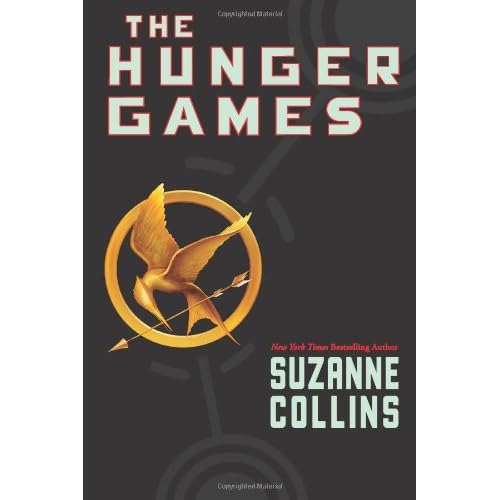
Review: The Hunger Games, by Suzanne Collins (@Scholastic)

I read The Hunger Games several months ago. I never wrote down my thoughts, because thousands before me already had, and I figured I probably didn’t have much to add. Then I read and reviewed a bunch of other young adult dystopian fiction, some good, some “eh,” and came to the conclusion that if I’m going to judge all of them against The Hunger Games, then I should probably go ahead and review The Hunger Games.

This is a review only of the first book.

We all know by now what The Hunger Games is about. In a future version of the United States (now called Panem), the country has been divided into 12 Districts, each specializing in a different industry, surrounding a central Capitol. Years ago, the Districts rebelled against the Capitol. The Capitol prevailed, and as punishment for the rebellion (and as a deterrent against future rebellion), each year the Capitol forces each District to sacrifice 2 of its citizens – a boy and girl between the ages of 12 and 18 – to fight to the death in a barbaric gladiatorial arena for the amusement of the Capitol’s citizens. One will survive. 23 will die.

The decadent and pampered Capitol citizens, desensitized to the actual horror of what they are watching, view the televised Games as the height of entertainment, Olympics and action movies and reality TV all rolled into one.

Meanwhile, the oppressed citizens of the 12 Districts live out a nightmare, as they are forced to watch their children mercilessly slaughtered on TV.

And rebellion is out of the question. Each District is patrolled by Capitol-appointed “Peacekeepers,” there to make sure that they willingly send their Tributes and watch the Games like they’re supposed to. To resist is to guarantee death – or worse.

The heroine of the book is Katniss Everdeen, a 16-year-old girl who has managed to avoid the Hunger Games for the past 4 years. But that all changes when her 12-year-old sister, Prim, is selected to be this year’s District 12 Tribute. Katniss, terrified for Prim, volunteers to take her place — a decision which most likely guarantees a gruesome death.

Katniss is shipped off to the Capitol to prepare for the Games, along with Peeta, the local baker’s son. They are primped and polished, interviewed and pampered, and ultimately turned loose in the arena with the other 22 tributes.

Every single one of them knows, if they are not prepared to fight to the death, they have no hope of winning. And a peaceful sit-in is not an option – the country is watching, and the Gamemakers will guarantee a good show, even if it means unleashing mutant wasps or raining down fire on the tributes.

I will admit, I spent the first half of the book convinced Katniss would certainly find a way to rebel against the Games. Surely she wouldn’t participate. Surely she wouldn’t kill anyone. Surely she wouldn’t fight Peeta. Surely something will happen to make it so that none of these children actually has to die.

But Katniss doesn’t go to the games to rebel. She goes to save her sister, and she goes to try to come back to her sister. Which means she has to win. Which means she has to participate. She’s a 16-year-old girl in a world that has accepted the Games as a part of life for 3/4 of a century.

Children do die in this book. It’s horrible and terrifying and heartbreaking. You want to scream at the Gamemakers and Capitol citizens, “What’s wrong with you?” The book gives a chilling look at the insensitivity that would turn a blind eye to the slaughter of children in the name of entertainment and tradition.

It also gives us, in Katniss, a very flawed young girl. She is angry, stubborn and judgmental. But she is also fiercely loyal, protective, and determined. I don’t agree with all of her decisions in the book. I was actually a much bigger fan of Peeta than Katniss. But I can admire her determination to do what she has to, to return to protect her sister. She clings to hope, even when all seems lost. In the world she lives in, it seems like the only choice she has.

As a parent, it saddened me greatly to think of a world where parents would be forced to send their children into a situation like this, and where children would be forced to endure this kind of brutality and despair. And if The Hunger Games was just a stand-alone story, I may not have enjoyed it as much, even though it’s an exciting and engrossing read. But it is the first book in a trilogy, and does an excellent job of setting up the world that Katniss and Peeta live in.

The first book is sad. I cared about the characters, but I hated the world they lived in. I hated what they had to go through. It’s upsetting. It’s horrifying. It made me angry. And it’s supposed to. If this is the feeling you’re left with after the first book, it’s not a sign to give up on the series. It’s a sign you need to see where it goes.

Content guide: Contains numerous descriptions of disturbing violence towards children, often resulting in death.