Discussion: Multiple POVs: Tool or Crutch?

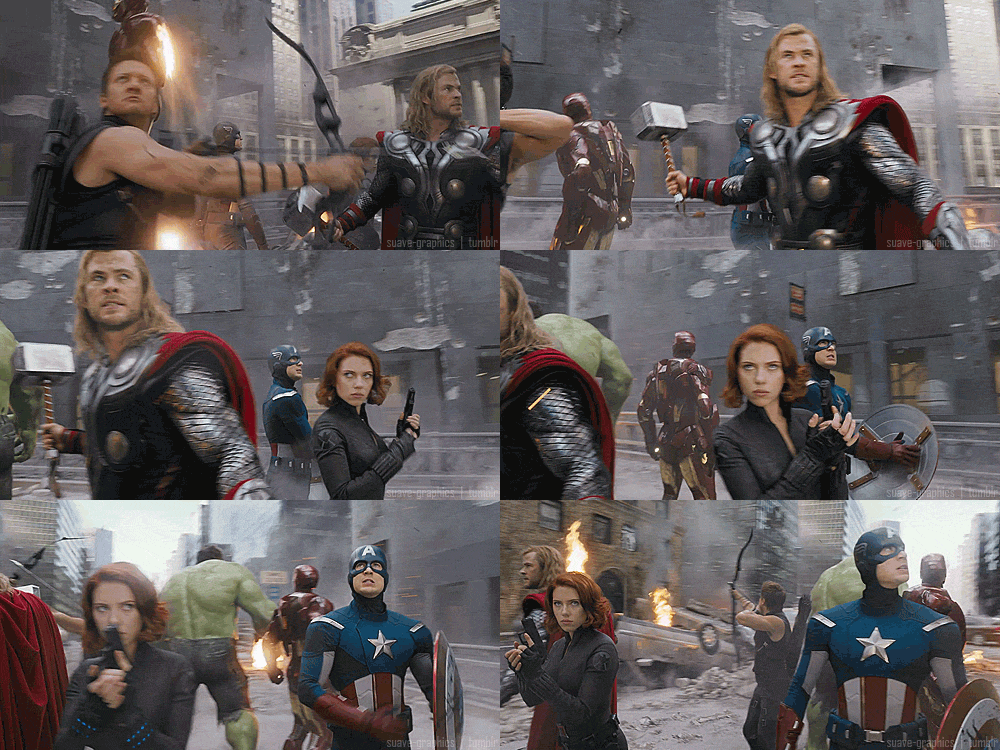
Multiple POV in a book = Ensemble cast in a movie

I’ve been reading a lot of books lately where the narrative follows multiple POVs (points of view. Which I guess means the abbreviation should be PsOV, but that looks WEIRD).  Sometimes it’s just two characters, other times it’s four or more. Then I go to other blogs or Goodreads and see what others thought of the book. One of the things I’ve noticed come up in reviews a lot, with feelings running the gamut of emotions, is that we have widely varying preferences on POV.

Some people love the additional insight into the characters that multiple POVs offer. Others think of it as authorial laziness, and wish the author would just stick with one character and develop him or her more.

With me, it really depends on the book. Sometimes I adore multiple POVs. Other times, I agree that it feels like the author just wasn’t trying very hard. Or there’s a third category — the author obviously had a strong case for including someone else’s POV, but their editor probably needed to step up and cut it. Because while the added POV does add something interesting to the story, it doesn’t add enough to justify its presence.

Let’s take a look at some books that fall into each of these categories, and why, in my opinion, they work or don’t work.

When it Works

To me, Robin Hobb’s Liveship Traders trilogy is the gold standard of multiple POVs used to great benefit. This is an adult high fantasy series, and I think one of the things working in its favor is the scope of the story (and the fact that adult high fantasy is allowed to have some length to it). Probably many of you haven’t read this one (although you SHOULD), but just bear with me a moment while I walk through the elements that make multiple POVs work well. I’ll apply them to books you’ve read soon, I promise.

The characters are all very different

This series has seven POVs, and that’s assuming I didn’t miss one. But all of them are very different, following characters that come from varied backgrounds, each with their own unique voice.

Shreever – a sea serpent

Kennit – a pirate captain

Wintrow – a boy priest

Brashen – a sailor

Althea – a daughter of a prominent Trader family

Ronica – the widow of a Trader

Malta – the young, spoiled daughter of a captain

All seven of them would view the same situation in seven completely different ways. But most of the time, they don’t have to, which brings me to my next point:

No single character is capable of telling the whole story

Yes, some of them are paired up in the same location, but none of them has all the information necessary to make the story work. Kennit is incapable of telling the reader what is happening in the town, because he spends the majority of the book on his ship. Brashin can’t tell you what’s happening on Kennit’s ship, because he’s on a different ship. And Ronica can’t tell us a thing about life at sea, because she remains in the town.

Now I’m not saying that characters must be divided geographically for multiple POVs to work. It can most definitely work if the characters are in the same location. But what must always be true is that the story can’t be told by only one character. Not that it would be difficult to tell. It needs to be impossible to tell. As in, if you forced the author to rewrite the book from the perspective of one character only, the story simply wouldn’t work.

Each character has their own, important story

No character’s POV is included unless they have their own unique story that must be shared for us to be able to understand the story as a whole. And as a result, while some characters are featured more prominently than others, every single POV has its own motivations, its own stakes, and its own plot arc.

Examples of When it Works:

When it Doesn’t Work

When only one (or none) of the above is true, it just flat out doesn’t work. Here’s some of the common pitfalls I’ve seen.

Narrators are too similar

I’m not sure if this is a case of author voice being too strong or character voice being too weak. I think normally, it’s the latter. This is especially prevalent in books where every POV is still told in first person, so you don’t even have helpful names and pronouns to let you know who’s speaking. If I can’t figure out whose story I’m reading, I get frustrated and it’s impossible for me to invest in the story.

Or maybe I can figure out who’s talking, but I can’t figure out why they’re talking. If I’m thinking, “Why do I need Steve’s point of view? I already have John’s point of view on the subject, and Steve seems to agree with him,” you’ve lost me.

Narrators don’t bring me new (or necessary) information

Maybe you’re writing a book about a girl searching for her kidnapped boyfriend. And you think, “Oooh, you know what would be neat? The scene where the boyfriend gets abducted!” And you figure, you can’t do that one from the girl’s point of view, so you write it from the boyfriend’s. And maybe you include a scene or two about the boyfriend huddled in the dark, and the kidnapper punches him in the face a few times, but really, most of the story is about the girl’s search and how she ultimately finds and rescues him.

Was the boyfriend’s POV necessary? No, and here’s why.

1) We know he was kidnapped. While the kidnapping scene may be awesome, it doesn’t give us new information, unless the method of his kidnapping was absolutely pivotal to the plot and the girl would have never been able to figure it out on her own. And even if that’s the case, it may still not work (see below).

2) The girl is probably assuming he is scared. And if, when she finds him, his cheek is bruised and his lip is bloody, and he looks haggard, we can pretty well assume the kidnapper roughed him up. It’s not necessary to include the scenes of those things happening, because it is not new information that we would not have had otherwise.

Narrators don’t have their own arc

Even in reason #1 up above, where the method of kidnapping is essential to the plot, if we never hear something relevant from Boyfriend again, his POV still doesn’t work. The author needed to find another way to let us know what the method of kidnapping was, even if it’s really hard. I’m not going to be invested in a character whose perspective I only share for one or two scenes. A narrator needs to tell a story, not just a single event.

Examples of When it Doesn’t Work:

*

When it Almost Works

And this one is tricky. If it almost works, I can still enjoy the book. Heck, I can even enjoy a book sometimes when it flat out doesn’t work (although in that case, I can’t LOVE the book).

When this happens, it’s pretty much always in books featuring three or more POVs. The author has a couple POVs working well, developing characters and arcs alongside each other, bringing us lots of necessary information…and then they slip in another one that’s not necessary. It kind of sneaks in, around all the stuff that is necessary, and it almost fools us into believing that we needed that character’s POV. But we didn’t. And any time we come across that character’s POV, the story starts to feel flat. So basically, the author could have had a solid multiple-POV book, but that one extra narrator kept it from completely working.

I can totally see why this happens. Authors love their characters. They want us readers to have ALL the information, because sometimes it’s painful to not show how fully developed and real these characters are in their heads. And when they are letting several other characters have their voice, and they’re all working well, I’d guess it can be extremely hard to see that this one character just isn’t working. But I would argue that there’s a way (albeit much more difficult for the writer) to develop those characters and give us all the necessary information without crawling inside their heads for a couple chapters.

Examples of When it Almost Works (Disclaimer: I still enjoyed these books):

I know I’ve read more than two books where it almost worked, but I honestly can’t think of what they were at the moment. It’s a pretty rare occurrence — normally the multiple POVs either work or they don’t.

So what do you think? Do you love multiple POVs or hate them? Does it depend on the circumstance? Are they necessary sometimes and superfluous at others? What books can you think of that I didn’t mention here that got it perfectly right (or horribly wrong)? 

*I know a lot of you may disagree with me on Legend, but I maintain that the narrators in that book sound exactly. The. Same.

Top Ten Tuesday (August 28) – Bookish Confessions

Welcome to Top Ten Tuesday, hosted by our friends over at The Broke and the Bookish!

Today’s topic is dangerous. I’m nervous. But here you go. In no particular order.

Top Ten Bookish Confessions

1. I dog ear pages. Not in my lovely new hardbacks, but in my old, well-worn paperbacks? You betcha.

2. I’ve been known to use books as coasters. Again, not the shiny new ones. But my old books have taken their share of abuse.

3. I check books out of the library ALL THE TIME without setting aside time to actually read them, and they wind up going back either unread or half finished. Yes. I am that annoying person who has the book you want. And I’m not even reading it.

4. I prefer Jane Austen movies to Jane Austen books. Love her characters and her stories. The books don’t hold my attention the way I wish they did.

5. I read while I eat lunch. I try my best not to get food on my books. Sometimes I fail. (Basically what we’re learning in these confessions is that I am disgusting.)

6. I can’t read Shakespeare. I love to see it dramatized, but when I see it on the page, I just get bored. My brain can’t turn the words on the page into this:

7. I didn’t like The Great Gatsby. At all. I don’t even want to see the movie.

8. Although I love all things supernatural in my stories, and I love many of his other books, I’ve tried reading Stephen King’s Dark Tower series twice, and failed both times. Can’t seem to make it past Book 4.

9. I enjoy a well-done love triangle.

10. While I’m not a fan of the actual writing and do think the story is intellectually absurd, I really enjoyed Twilight. And Breaking Dawn was my favorite, even though it makes the least amount of sense and has the worst ending.

Review: The Rise of Nine by Pittacus Lore (@harperteen)

Received an advance digital review copy from Edelweiss

The Rise of Nine is Book #3 in Pittacus Lore’s Lorien Legacies series (the first two are I am Number Four and The Power of Six), about teenage aliens with superpowers destined to save the world. If you have read my blog for more than about five minutes, you know that this concept holds massive appeal for me. Teen aliens with superpowers are awesome (as an aside, if you agree with that statement and haven’t watched Roswell yet, you need to get on that, stat). And while I think the Lorien Legacies are kind of cheesily written and won’t be touted as Great Literature anytime soon (or ever), they’re still a high-energy series of books that completely succeed in keeping me thoroughly entertained. And honestly, in a series about teen aliens with superpowers that’s ghostwritten by an alien, I’m pretty sure entertainment is the sole purpose.

The Plot (from Goodreads)

Until the day I met John Smith, Number Four, I’d been on the run alone, hiding and fighting to stay alive.

Together, we are much more powerful. But it could only last so long before we had to separate to find the others. . . .

I went to Spain to find Seven, and I found even more, including a tenth member of the Garde who escaped from Lorien alive. Ella is younger than the rest of us, but just as brave. Now we’re looking for the others–including John.

But so are they.

They caught Number One in Malaysia.
Number Two in England.
And Number Three in Kenya.
They caught me in New York–but I escaped.
I am Number Six.
They want to finish what they started.
But they’ll have to fight us first.

My Thoughts

Although the synopsis is written from the POV of Number Six, The Rise of Nine actually shifts between three POVs: John Smith (Number Four), Number Six, and Marina (Number Seven). I’m wondering if this is going to become a thing with this series. Book #1 had one POV, Book #2 had two, and now Book #3 has three. But because all of the POVs are written in the first-person and the voices really aren’t that different, it can start to get confusing. I kind of hope Book #4 reins it in and doesn’t add yet another POV to the mix.

Speaking of which, I totally thought this was a trilogy until I realized I was at the last chapter and there was no way things were going to resolve by the end of the book. Which is mostly fine, but there’s a couple plot points I can’t believe are still dangling, including the whereabouts of my favorite character. In case anyone wonders, apparently there are going to be six books. Which you probably already knew, but I didn’t.

But anyway, moving away from that, let’s talk about the book. So as I said, there are three POVs. And I’m not entirely sure they were necessary. Marina and Number Six’s voices were kind of interchangeable, until they get split up and you can tell who’s speaking based on the setting. However, that’s a pretty late-stage development, and I don’t think we needed to stick with Marina through it. Probably just John and Six’s voices would have sufficed and been less confusing. It wasn’t really a bad thing, just sometimes hard to figure out who was talking. I had to back up a page on several occasions to double-check the narrator.

As for the plot, it had all the crazy action I’ve come to expect from this series. I loved the addition of Number Nine and Number Eight to the mix. They provided some fun new powers and personalities, and I got excited every time another member of the Garde joined the group. We didn’t really learn much more about Lorien’s history in this book, which was kind of sad (I love learning about Lorien), but the increased action made up for it for the most part. I am a sucker for awesome new superpowers and gadgets and giant explosions, and there are plenty of all of the above. The best thing about this series is the action, and this book really played to its strengths.

Getting to the writing, even on the sliding scale that I use to judge writing (I’m not going to hold an action book about teen aliens to the same standard as high fantasy), I had one major gripe about the writing. Actually, it’s not major. In the grand scheme of things, it’s minor. But it irked the heck out of me. And that is the phrase “with my telekinesis”  and all its variations.

I used my telekinesis to push the plane”

“I’m able to deflect [the sticks] with my telekinesis”

“I use my telekinesis to pull on the tail of one of the helicopters”

And about a thousand other mentions of the Garde using their telekinesis to move, lift, throw, tear, float, and otherwise manipulate their surroundings.

I have absolutely no problem with the fact that all of the members of the Garde have telekinetic powers and that they use them all the time. I would too, if I had telekinesis. But since this is a thing that all of them can do, and they all use it like another extension of their body, constantly reminding us that they’re doing it with their telekinesis is redundant. If you’re ripping a helicopter from the sky, and I know you have telekinesis, I’m pretty sure you’re not doing it with your nose. It’s like saying “I kicked the ball with my foot” or “I picked up the book with my hand.” You don’t need to tell us what part of your body you used to do something. It’s assumed. Stop telling me that you are doing things in the only practical way you could do them.

Okay. Rant about telekinesis over.

Aside from that, the writing flows well, the pacing is good, and the action scenes (which are a good chunk of the book) were exciting. I enjoy this series with the same part of my brain that enjoys Michael Bay movies (admit it. Transformers was super fun). I still don’t really understand the title (we found out in Power of Six that there are actually ten Garde members, three of which died at the beginning of I am Number Four, and we met Number Nine at the end of the last book and he doesn’t do much “rising” in this one. It’s a mystery), but I don’t care too much. This isn’t a big “thinking” series. It’s about superpowers and explosions and adrenaline, and I highly enjoy it.

Content guide: Contains violence and profanity

Feature & Follow (August 24) – Worst Cover on a Great Book

Welcome to the Feature & Follow Hop, hosted by Parajunkee’s View and Alison Can Read!

If you’re here for the first time, I’d love if you could follow via email, RSS, LinkyFollowers or Networked Blogs. Just let me know your follow method of choice in the comments, and I’ll be happy to return the favor.

And if you’re not new, welcome back! Repeat visitors are better than a Snuggie on a cold night. (Come on. You know Snuggies are awesome.)

This week’s question:

Q: Worst cover? What is the worst cover of a book that you’ve read and loved?

Oh good, this one’s easy. I really, really loved this book. I hate the cover. So much that I will never buy a physical copy of this book, even though I am all about physical copies, because I don’t want it on my shelves. Digital only for me.

1. I understand that the tear of blood is actually very  relevant to the plot, but ewwwww.

2. WHY IS SHE WHITE? NO. Unacceptable. (If you haven’t read it, the main character is Asian.)

(Seriously though, it’s an awesome book).


#SYTYCD Book Pitch – Season 9, Week 5 (@DANCEonFOX)

I skipped this feature last week because all the routines were rehashes of old routines (which…not a giant fan of that, gotta be honest). Plus, one of the routines already inspired a book. If you want to see the re-interpretation, here you go.

But anyway, after the two-week hiatus and then skipping last week, I feel like I haven’t done one of these in forever. Fortunately, last night’s episode had several fantastic dances to pick from.

[Getting away from the point of this post for a second, I just want to go on record as saying that I. Love. All-Stars. Especially after my favorite dancer was eliminated last week, and I now don’t have a serious emotional investment in the competition, the main reason I was looking forward to this week’s episode was to see who they brought back as All-Stars. And oh my goodness. Kathryn McCormick. Jakob Karr. Brandon Bryant. Alex Wong. Yes yes yes YES.]

So there were a lot of fantastic and emotional routines last night, and the one I’m picking wasn’t necessarily the best one (although I really enjoyed it), but it’s the one that most screamed “story!” to me. And it doesn’t hurt that the All-Star was one of my top 3 guys to ever compete on this show. I could watch him dance every day for the rest of my life and never get tired of it. Seriously.

Song: Dancin’ Dan (Me and My Shadow) (Fosse Original Broadway Cast)

Choreographer: Spencer Liff

Dancers: Lindsay and Jakob Karr (Season 6)

Book Pitch: When a teenage outcast stumbles upon a spell to bring her shadow to life, she begins to plan the perfect crime. But when her shadow develops a conscience, her plot may be thwarted by…herself?

(I honestly don’t know how my brain went from that dance to “crime,” but there it is. My mind is a strange, strange place).

Suggested Author: This one kind of needs a creative genius because the concept is so weird, so I’m going to play the J.K. Rowling card. I may wind up regretting using a lifeline so early, but we’ll see in the coming weeks.

You know what other video goes really well with that dance? This one. 

If So You Think You Can Dance and Lindsey Stirling ever want to combine forces, I think the universe may explode, in a good way.

Week 3 Book Pitch

Week 2 Book Pitch

Week 1 Book Pitch

The original SYTYCD Book Pitch post